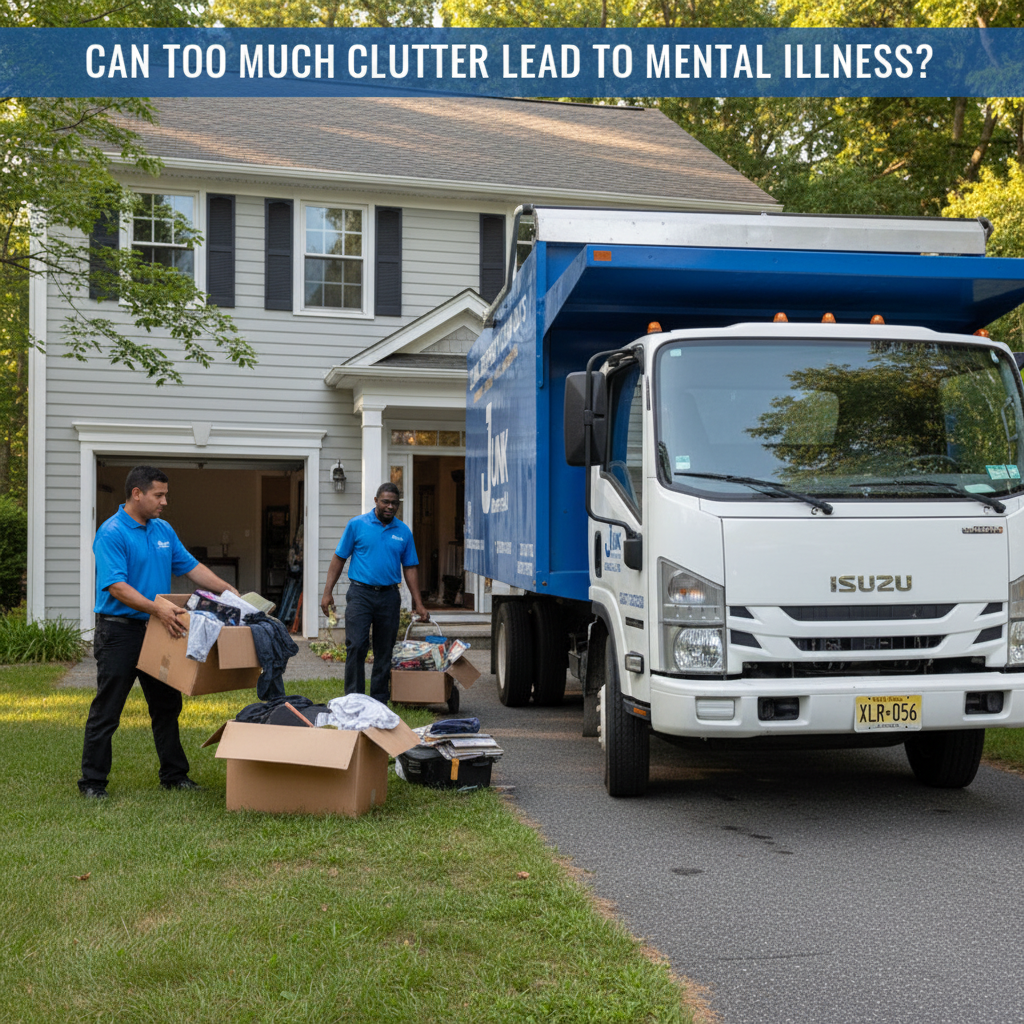
Can Too Much Clutter Lead to Mental Illness?
If you’ve ever looked around your home and felt your chest tighten, your mind race, or your motivation disappear, you’re not imagining it: your environment can affect how you feel. But does that mean clutter can cause mental illness?
The honest, science-respecting answer is: clutter doesn’t automatically cause mental illness—but it can increase stress, worsen symptoms like anxiety and depressed mood, and fuel a feedback loop that makes mental health harder to manage. In some cases, severe clutter is also a symptom of a diagnosable condition (such as hoarding disorder), not just a “mess problem.”
Table of Contents
- The Short Answer
- What Counts as “Clutter” (and What Doesn’t)
- What Research Suggests About Clutter, Stress, and Mood
- Why Clutter Can Feel Mentally “Loud”
- Does Clutter Cause Mental Illness—or Reveal It?
- The Clutter–Mental Health Cycle (How It Snowballs)
- When Clutter Becomes a Clinical Concern: Hoarding Disorder
- What Helps: Practical Steps (Without Perfection)
- How to Help Someone Else Without Shame or Power Struggles
- FAQ
The Short Answer
Yes—too much clutter can contribute to mental strain. Studies have linked cluttered or “unfinished” home environments with biological stress patterns and worse mood in daily life.
No—clutter alone doesn’t automatically create a mental illness in everyone. Mental illness is complex and influenced by many factors (biology, stress, trauma, sleep, substance use, social support, life circumstances, and more).
What’s most accurate is this: clutter and mental health often influence each other. Clutter can raise stress and reduce your sense of control, while anxiety, depression, ADHD, grief, or trauma can make it harder to tidy, organize, or discard—so clutter grows.
What Counts as “Clutter” (and What Doesn’t)
Clutter isn’t the same thing as “having stuff.” Clutter is more like too many possessions for the space and systems you have, leading to chaos, friction, and unfinished decisions.
Examples of typical clutter
- Piles of paperwork you avoid sorting
- Overflowing closets and drawers
- Rooms that function… but feel constantly “behind”
Clutter is not automatically hoarding
A messy house can happen after a move, a new baby, a busy job season, or a tough health period. That’s very different from hoarding disorder, which has specific clinical features like persistent difficulty discarding, distress when discarding, and clutter that compromises living spaces (more on that below).
What Research Suggests About Clutter, Stress, and Mood
Research on everyday clutter is still developing, but several studies point in the same direction: when people experience their homes as cluttered and stressful, mental well-being tends to be lower.
Clutter and stress biology (cortisol)
In a frequently cited study, researchers analyzed how people described their homes during “home tours,” focusing on words related to clutter and an unfinished home. Wives who had higher “stressful home” scores showed a flatter diurnal cortisol slope and higher depressed mood patterns across the day—signals associated with stress and poorer health outcomes. This doesn’t prove clutter causes depression, but it supports a meaningful link between home environment, stress physiology, and mood.
Clutter and well-being
Other research in general (non-clinical) populations has found that subjective clutter—how cluttered a person feels their home is—can strongly predict well-being outcomes. In other words, the mental “weight” of clutter may matter as much as (or more than) the objective number of items.
Takeaway: While study designs vary, the pattern is consistent—clutter is often associated with higher stress and lower well-being.
Why Clutter Can Feel Mentally “Loud”
Clutter isn’t only physical—it’s also informational. Every pile you step around is a reminder of an unfinished decision: keep, toss, donate, repair, file, return, sell, or “deal with later.” That constant background noise can drain attention and increase mental load.
This effect isn’t just metaphorical. Neuroscience research on visual clutter suggests that clutter in the visual field can alter how information flows in the brain, influencing how we process what we see. That helps explain why cluttered spaces can feel harder to focus in, even when you’re not actively “thinking about the mess.”
Does Clutter Cause Mental Illness—or Reveal It?
This is the key nuance most headlines miss:
Clutter is usually more correlated than causal. Many studies are cross-sectional (a snapshot in time), which means they can show “these two things tend to occur together,” but not “this one thing caused the other.”
For example, research on “household chaos” (a broader concept that includes noise, crowding, lack of routine, and disorder) has found associations with anxiety and depression symptoms—but the authors also note that causality can run the other way: mental health problems can lead to a more disorganized home environment.
So what’s the most realistic conclusion?
- Clutter can worsen stress, anxiety, and depressed mood.
- Mental health symptoms can make clutter much more likely to accumulate.
- Both can be true at the same time—creating a loop.
The Clutter–Mental Health Cycle (How It Snowballs)
Here’s how the cycle often looks in real life:
- Stress, depression, anxiety, grief, or burnout reduces energy and decision-making.
- Basic tasks feel heavier (laundry, dishes, paperwork, donating items).
- Clutter builds, making the home feel overwhelming and harder to reset.
- Overwhelm triggers avoidance (“I can’t deal with that right now”).
- Avoidance increases shame and stress, which worsens mental health symptoms.
- The loop repeats, and clutter becomes both a symptom and a stressor.
This is why people can feel “stuck” for months or years—even when they desperately want a fresh start.
When Clutter Becomes a Clinical Concern: Hoarding Disorder
Most clutter is not hoarding disorder. But sometimes clutter is a sign of a diagnosable condition—especially when the primary issue isn’t cleaning, but discarding.
What hoarding disorder looks like clinically
Clinically, hoarding disorder involves:
- Persistent difficulty discarding possessions (regardless of value)
- Distress when discarding or even thinking about discarding
- Clutter that congests living areas and compromises their intended use
- Significant distress or impairment (including safety risks)
Hoarding disorder can also include excessive acquiring (bringing in items that aren’t needed or there’s no space for), and clinicians also consider insight—whether the person recognizes the issue or feels convinced nothing is wrong.
Red flags that suggest it’s time for professional support
- Rooms can’t be used for their intended purpose (bedroom, kitchen, bathroom)
- Blocked exits, tripping hazards, fire risks, pests, or sanitation issues
- Severe distress, conflict, or isolation caused by the clutter
- You “want to declutter,” but feel panic or grief at discarding even low-value items
If these sound familiar, a mental health professional (especially one familiar with hoarding) can help—because the best support targets the emotional drivers, not just the piles.
What Helps: Practical Steps (Without Perfection)
If clutter is affecting your mood or stress levels, the goal isn’t a magazine-perfect home. It’s reducing friction, restoring function, and giving your brain fewer “open loops.”
1) Start with “function first” (harm reduction)
- Clear a safe walkway
- Restore one usable surface (kitchen counter, desk, nightstand)
- Make sure exits are accessible
2) Use tiny time blocks
Try 10 minutes a day. Stopping while you still have energy builds consistency and reduces burnout.
3) Reduce inflow for two weeks
If new items keep entering, decluttering feels pointless. Pause non-essential purchases, freebies, and “just-in-case” items temporarily.
4) Make decisions easier with containers
Give each category a container limit (one bin for cables, one shelf for tools, one box for papers-to-file). If it doesn’t fit, something must leave—no debate required.
5) If mental health is the root, treat the root
If clutter is tied to depression, anxiety, ADHD, grief, or trauma, addressing the underlying condition can make home tasks dramatically more manageable. Sometimes the best “decluttering tool” is therapy, medication support, or structured coaching—not willpower.
How to Help Someone Else Without Shame or Power Struggles
If you’re supporting a loved one, it’s natural to feel frustrated. But shame tends to create hiding and avoidance—not sustainable change.
More effective approaches usually include:
- Lead with safety: “I’m worried about blocked exits,” not “This is disgusting.”
- Ask permission: secret cleanouts can break trust and increase distress.
- Start small: one zone, one bag, one drawer.
- Offer choices: “Do you want to start with clothes or papers?”
- Encourage specialized help: especially if hoarding disorder may be involved.
FAQ
So… can clutter actually cause anxiety or depression?
Clutter can increase stress and worsen anxiety/depressed mood, and studies show meaningful associations between cluttered home experiences and stress/mood patterns. But “cause” is a strong word—often the relationship is bidirectional.
Is clutter a sign of mental illness?
Sometimes clutter is purely practical (busy life, temporary hardship). Other times it’s linked to conditions like depression (low energy), ADHD (executive function challenges), or hoarding disorder (difficulty discarding + distress + impaired living spaces). Context matters.
When should someone seek professional help?
If clutter is causing serious distress, unsafe conditions, conflict, isolation, or inability to use living spaces—or if discarding triggers intense distress—professional mental health support is a strong next step.
Bottom Line
Too much clutter can absolutely affect your mental health—especially stress, focus, and mood. But it’s rarely as simple as “clutter causes mental illness.” More often, clutter is part of a two-way relationship where mental strain and environmental strain reinforce each other.
The most effective path forward is usually a blend of: small, practical environmental wins + reducing inflow + addressing underlying mental health needs.
Source notes Study linking “stressful home” language (including clutter/unfinished descriptors) to cortisol patterns and daily depressed mood patterns (association, not proof of causation). PubMed +1 Evidence that subjective clutter / psychological home variables predict well-being in general populations (correlational findings). ScienceDirect +1 Neuroscience reporting that visual clutter can alter information flow in the brain (mechanistic plausibility for attention/overload effects). National Eye Institute +1 Household “chaos” research showing associations with anxiety/depression symptoms and explicitly noting cross-sectional limits and possible reverse direction (mental health → disorganized environment). PMC DSM-5 criteria details for hoarding disorder, including impaired living spaces, excessive acquisition specifier, and insight specifier. NCBI APA patient/family overview of hoarding disorder (definition, consequences, comorbidity notes). American Psychiatric Association Mental Health America resource noting clutter can be harmful to mental state and suggesting small-step tidiness strategies (general guidance). Mental Health America